
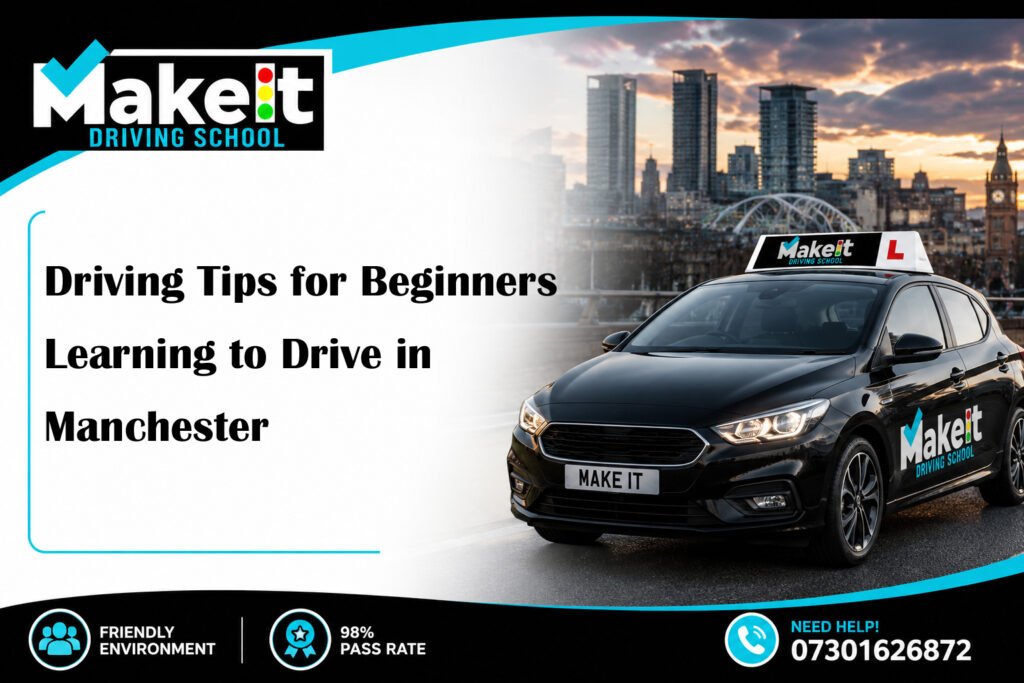
Learning to drive is an exciting step, but getting behind the wheel for the first time can also feel overwhelming. When you are learning to drive in Manchester, you may need to become comfortable with busy roads, roundabouts, traffic lights, buses, cyclists, pedestrians and different types of junctions. At the beginning, it can feel like there is too much to think about at once.
The good news is that you do not need to master everything immediately. Driving is a skill that develops gradually through professional instruction, regular practice and experience. As you become more familiar with the vehicle and Manchester roads, many of the actions that initially require a lot of concentration will start to feel more natural.
If you are just starting your driving journey, having a clear plan can make the process much easier. From getting your provisional licence and learning the Highway Code to taking lessons, preparing for your theory test and eventually taking your practical driving test, every stage has an important purpose. GOV.UK currently recommends starting with the appropriate licence, professional lessons and theory preparation before progressing towards the practical test.
Get Your Provisional Driving Licence
Before you start learning to drive a car on public roads, you need the appropriate provisional driving licence. In Great Britain, you can apply for a provisional licence before you are old enough to drive, and you can usually start learning to drive a car from age 17.
Having your provisional licence ready allows you to begin your driving lessons legally. It is worth completing this stage early if you are planning to start learning soon, because you will need the licence for your lessons and later for your theory and practical tests.
Once you have your provisional licence, you can begin looking for a suitable driving instructor in Manchester. Choosing an instructor who explains things clearly and adapts lessons to your progress can make a significant difference to your experience as a learner.
Choose a Driving Instructor Who Suits You
Not every learner has the same learning style. Some people become comfortable with vehicle controls quickly, while others need more time to develop confidence. A good instructor should understand this and adjust the pace of your lessons accordingly.
The DVSA’s Ready to Pass guidance recommends choosing an instructor who is reliable, adapts teaching to the learner and focuses on helping students become safe drivers rather than simply getting them through the test.
When you are looking for driving lessons in Manchester, consider whether the instructor makes you feel comfortable asking questions. You should be able to say when you do not understand something and receive a clear explanation without feeling pressured.
Learn the Basic Controls First
Your first few lessons will normally focus heavily on getting comfortable with the vehicle.
You need to understand how the steering, pedals, gears, handbrake, indicators, mirrors and other controls work. If you are learning in a manual car, clutch control and gear changes will require additional practice. If you are learning in an automatic, you will still need to develop accurate steering, braking, acceleration and observation skills.
Do not worry if controlling everything feels difficult during your first lessons. Your instructor will introduce the controls gradually, and repetition will make them easier.
The goal is eventually for basic vehicle controls to become familiar enough that you can concentrate more on what is happening around you.
Develop Good Steering Control
Steering is one of the first skills you will need to become comfortable with.
As a beginner, you may initially make larger steering movements than necessary. You may also find it difficult to judge exactly where the car is positioned on the road.
With practice, you will become better at making smooth steering movements and maintaining the correct road position.
Avoid constantly looking at the steering wheel. Your eyes should be focused on the road and where you want the vehicle to go. Looking further ahead can help you make smoother steering corrections.
Learn to Move Off and Stop Smoothly
Moving off and stopping are basic skills, but they are extremely important.
You should learn how to prepare the vehicle, observe your surroundings, move away safely and build speed appropriately. Stopping should also be controlled and predictable.
If you are learning in a manual car, clutch control can take time to master. You may stall occasionally while learning, and that is completely normal. Instead of becoming frustrated, try to understand what caused the stall and use your next attempt to improve.
Once moving off and stopping become comfortable, you will feel much more relaxed on Manchester roads.
Understand the Highway Code
Learning to drive is not only about controlling a car. You also need to understand the rules and responsibilities that apply to drivers.
The Highway Code provides important information about road signs, road markings, junctions, speed limits, pedestrians, cyclists, parking, roundabouts and many other aspects of road safety.
It is useful to study the Highway Code alongside your practical lessons because you can then connect what you read with what you experience on the road.
The official theory-test guidance confirms that theory-test questions are based on resources including the Highway Code, traffic signs and essential driving skills.
Practise Your Observation From the Beginning
Good observation is one of the most important skills you can develop as a learner.
Do not only look directly in front of your car. You should gradually learn to scan the road, check mirrors, notice signs and markings, identify pedestrians and cyclists and recognise possible hazards.
When approaching a junction, for example, you should already be thinking about what might happen before you reach it.
Observation gives you more time to react and make decisions.
The sooner you develop this habit, the easier it becomes to handle more complicated Manchester roads later in your training.
Learn to Use Your Mirrors Properly
Mirrors provide essential information about what is happening around your vehicle.
You should develop a regular mirror-checking routine and use the relevant mirrors before actions such as changing speed, changing direction or changing lanes.
Do not simply glance at a mirror without processing what you see.
Ask yourself what the information means. Is another vehicle approaching? Is a cyclist alongside you? Is someone following closely? Is there enough space to change lanes?
Good mirror use is about awareness rather than simply completing a routine.
Keep Your Speed Under Control
New drivers sometimes worry about driving too slowly, particularly when other vehicles are behind them.
Your priority should be maintaining a safe and appropriate speed for the road and traffic conditions.
You should not drive unnecessarily slowly, but you also should not increase your speed simply because another driver is waiting behind you.
As your confidence improves, your speed will become more natural.
Your instructor can help you understand how to choose an appropriate speed for residential roads, urban routes, larger roads, roundabouts and other Manchester driving environments.
Learn How to Deal With Junctions
Junctions can feel complicated when you are a beginner because you have to consider traffic coming from different directions.
Start with simpler junctions and gradually progress to more demanding situations.
Approach junctions at an appropriate speed, look carefully and make sure you understand where you are going before committing to the manoeuvre.
Do not rush simply because a vehicle is waiting behind you.
With practice, you will become better at judging gaps and making safe decisions.
Practise Roundabouts
Roundabouts are an important part of learning to drive in Manchester.
You need to understand how to approach different roundabouts, choose the correct lane, read signs and road markings, give appropriate priority and safely leave at your intended exit.
Do not worry if roundabouts feel confusing at first.
Your instructor can begin with simpler roundabouts and gradually introduce larger or busier ones as your confidence improves.
Eventually, the process of identifying your exit, selecting your lane and observing traffic becomes much more familiar.
Become Comfortable With Busy Roads
Manchester has many busy urban roads, and you will eventually need to become comfortable driving in heavier traffic.
You may encounter queues, buses, cyclists, parked cars, pedestrians and vehicles changing lanes.
Do not try to master all these situations at once.
Gradually increase the difficulty of your lessons as your basic skills improve.
The purpose of learning is not to avoid difficult roads but to develop the ability to handle them safely.
Learn to Deal With Traffic Queues
Traffic queues are normal when driving in Manchester.
New drivers sometimes become nervous when vehicles are close together and traffic repeatedly stops and starts.
The key is to remain patient and maintain an appropriate gap.
If you are driving a manual car, traffic queues also give you an opportunity to practise smooth clutch control and low-speed vehicle control.
Do not worry about how quickly you are moving. Focus on maintaining control and observing what is happening ahead.
Pay Attention to Pedestrians
Manchester can have significant pedestrian activity, particularly around shopping areas, public transport stops, schools and busy town-centre locations.
Always look for pedestrians who may be crossing or preparing to cross.
Do not focus exclusively on other vehicles.
A person may step into your path unexpectedly, particularly near parked cars or busy junctions.
Developing strong pedestrian awareness will help you become a safer driver in both Manchester and other cities.
Be Aware of Cyclists and Motorcyclists
Cyclists and motorcyclists can sometimes be harder to notice because they are smaller than cars.
Check your mirrors regularly and pay particular attention before turning or changing lanes.
Do not make sudden movements.
When passing a cyclist, make sure there is sufficient space and avoid attempting to squeeze through a narrow gap.
Your instructor can help you understand how to share the road safely with different types of road users.
Learn to Deal With Parked Cars
Parked cars can make some Manchester roads feel much narrower.
You may need to move around parked vehicles while watching for approaching traffic.
Do not assume that you can simply drive around an obstruction without checking.
Look ahead, assess the available space and be prepared to wait if necessary.
Also watch for doors opening and pedestrians stepping out from between parked vehicles.
Practise Parking From Early On
Parking should become a normal part of your driving lessons rather than something you only practise shortly before your test.
You may need to learn parallel parking, forward parking into a bay and reverse parking into a bay.
Focus on slow-speed control, observation and accuracy.
Do not worry if you need to make an adjustment. Parking is about getting the vehicle safely into position, not completing every manoeuvre perfectly in one movement.
Do Not Be Afraid of Making Mistakes
Every learner makes mistakes.
You may stall the car, miss a turning, hesitate at a junction or position the vehicle incorrectly.
What matters is how you learn from these experiences.
Your instructor can explain what happened and show you how to approach the situation differently next time.
Trying to avoid every possible mistake can actually make you more nervous. Instead, concentrate on understanding what happened and improving gradually.
Practise Between Lessons When Appropriate
Private practice can be useful once your instructor believes you have reached a suitable level.
If you practise with family or friends, you must follow the relevant legal requirements, including having appropriate insurance and using the correct learner plates. Your supervisor must also meet the legal requirements for supervising a learner.
Private practice should complement professional lessons rather than replace them.
Your instructor can teach you correct techniques and identify habits that need improvement, while additional supervised practice can give you more experience using those skills.
Start Preparing for the Theory Test Early
You do not need to wait until your practical lessons are nearly finished before thinking about your theory test.
Studying the Highway Code and practising theory questions alongside your driving lessons can help you understand the reasons behind the actions your instructor teaches.
The car theory test has two parts, multiple-choice questions and hazard perception, and you need to pass both parts.
Regular study is generally more effective than trying to learn everything immediately before your test.
Spend a little time each week reviewing road signs, rules, hazards and driving situations.
Practise Hazard Perception
Hazard perception is an important part of your theory test preparation.
You need to learn to identify developing hazards rather than simply noticing things that are already dangerous.
Your practical lessons can help because you will see real examples of hazards on Manchester roads.
You might notice a pedestrian approaching a crossing, a parked vehicle that could move, a cyclist near a junction or traffic beginning to slow ahead.
Learning to recognise these situations early can improve both your theory preparation and your real-world driving.
Get Used to Independent Decision-Making
As a beginner, your instructor may give you frequent instructions.
As you improve, however, you should gradually take more responsibility for your driving decisions.
You need to learn how to follow road signs, choose appropriate lanes, plan your route and respond to changing traffic without waiting for your instructor to tell you exactly what to do.
This is particularly important before your practical test because you need to demonstrate that you can drive safely without constant instruction.
GOV.UK states that you should only take the practical test when you are able to drive safely in different road and traffic conditions without instruction.
Learn the Roads Around Manchester
Getting familiar with the types of roads around Manchester can help you feel more comfortable as your training progresses.
However, do not become dependent on memorising one particular route.
You should be able to respond to road signs, traffic conditions and unexpected situations even when you are driving somewhere unfamiliar.
A good instructor will introduce you to different road environments so that you develop adaptable driving skills.
This is much more useful than simply learning one route for your test.
Prepare for Your Driving Test Step by Step
As your driving improves, you will eventually begin preparing specifically for the practical test.
Make It Driving School has a useful resource covering the Step-by-Step Guide to Getting Your Driving Licence in Manchester.
Understanding the complete process can help you know what to expect and prevent the test from feeling like a sudden final step.
Your instructor can also monitor your progress and tell you which areas still need improvement before you book your test.
Do Not Book Your Practical Test Too Early
It can be tempting to book a test as soon as you feel reasonably comfortable.
However, being able to drive around familiar roads does not necessarily mean you are ready for the practical test.
You need to be able to deal with different road and traffic conditions safely and independently.
GOV.UK states that there is no minimum number of lessons required before taking the test, but you should only take it when you are ready to drive without instruction.
Your instructor can help you judge when your driving has reached the required standard.
Consider Mock Driving Tests
A mock driving test can be a useful step before the real test.
It allows you to experience a more realistic test-style drive and can show you which areas need additional practice.
You may discover that you drive well during normal lessons but become nervous when you are being assessed. A mock test can help you become familiar with that pressure before your actual test.
It can also help your instructor identify smaller issues that may need attention.
Build Confidence Instead of Chasing Perfection
You do not need to become a perfect driver before you can progress.
Instead, focus on becoming safe, consistent and increasingly independent.
One week you might improve your roundabouts. The next week you might become more confident with parking. Later, you may start feeling comfortable on busy roads.
These small improvements add up.
The goal is to become a driver who can assess situations calmly and make safe decisions rather than someone who has simply memorised a collection of test manoeuvres.
Stay Patient With Your Progress
Every learner progresses differently.
Some people need fewer lessons to become comfortable with vehicle control, while others need more time to develop observation and confidence.
Do not compare yourself with friends or other learners.
If a particular skill is difficult, spend more time practising it.
A patient approach can prevent unnecessary anxiety and help you enjoy the learning process.
Choose a Learning Approach That Works for You
Some learners prefer regular weekly lessons because they enjoy having time between sessions to think about what they have learned. Others may prefer a more intensive approach because their schedule allows them to practise more frequently.
The important thing is to choose a learning pattern that allows you to make steady progress.
Make It Driving School provides driving lessons in Manchester for learners developing their skills from the beginning, with options designed around different learning needs and schedules.
Why Choose Make It Driving School
Choosing a suitable driving school can make the learning process much easier.
Make It Driving School focuses on helping learners develop practical driving skills, road awareness and confidence while learning around Manchester. The school offers manual and automatic driving lessons and aims to provide a supportive environment for learners.
For a beginner, having an instructor who can explain difficult situations clearly and introduce new challenges at the right pace can make a significant difference.
Your first priority should always be learning to drive safely and confidently. Passing the test should be the result of that preparation rather than the only objective.
Final Thoughts
Learning to drive in Manchester can feel challenging when you are just starting, but you do not need to master everything at once. Begin with the basics, become comfortable with your vehicle and gradually build your observation, road positioning and decision-making skills.
Study the Highway Code alongside your practical lessons, practise hazard perception and learn how to recognise potential problems before they become emergencies. As your confidence develops, move from quieter roads to busier Manchester routes, larger junctions, roundabouts and more complex traffic conditions.
Remember that making mistakes is part of learning. The important thing is to understand your mistakes, listen to your instructor and keep improving. With regular practice and professional guidance, situations that initially seem difficult can eventually become routine.
If you are a beginner looking for driving lessons in Manchester, contact Make It Driving School to discuss your lessons and start building your driving skills.
You can also call 07301626872 to speak with the team.
With the right instructor, regular practice and a patient approach, you can develop the confidence and skills needed to become a safe and independent driver in Manchester.