
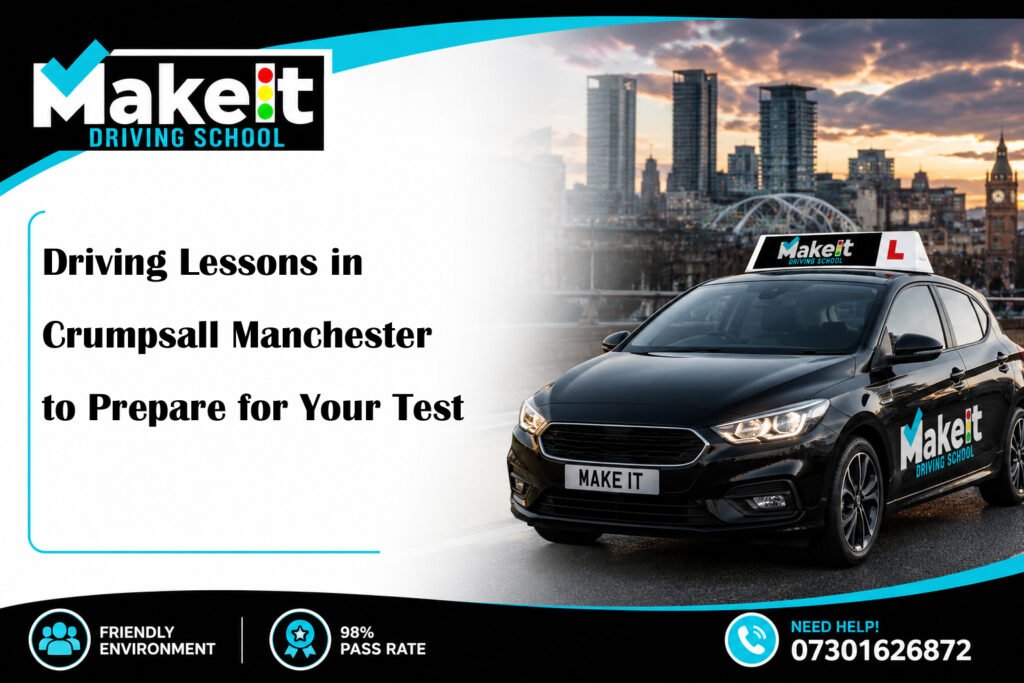
Preparing for your driving test is an important milestone, especially if you want to become a confident, independent, and responsible driver. For learners in Crumpsall, Manchester, professional driving lessons can provide the practical experience and guidance needed to develop essential driving skills and prepare for the challenges of the practical test. From understanding road signs and approaching junctions to performing manoeuvres and responding to traffic, every lesson can help you work towards becoming a safer driver.
Crumpsall offers a variety of road environments that can help learners develop their abilities. Residential streets provide opportunities to practise basic vehicle control, while busier roads introduce more complex traffic situations. Learning how to manage these different conditions can help you improve your observation, judgement, and decision-making before your test.
At Make It Driving School, learners can discuss their experience, preferred lesson type, and preparation goals with professional instructors. Whether you have recently started driving or have already completed several lessons, a structured training approach can help you identify areas for improvement and prepare more effectively for your practical test.
Why Driving Lessons Matter Before Your Test
Passing the driving test requires more than simply knowing how to operate a vehicle. You must demonstrate that you can drive safely, observe road conditions, follow traffic rules, and make appropriate decisions without relying on constant instructions from an instructor.
Professional driving lessons help you develop these abilities through guided practice. An instructor can assess your current driving standard, explain mistakes, and recommend exercises that address specific weaknesses. This makes it easier to understand what you need to improve before booking or taking your practical test.
Some learners need additional practice with roundabouts, while others may struggle with mirror checks, positioning, parking, or judging gaps in traffic. Identifying these issues early allows you to work on them systematically rather than discovering them shortly before the examination.
Regular lessons can also help you become familiar with the expectations of the practical test. Understanding how to demonstrate safe observations, maintain suitable speed, respond to hazards, and complete manoeuvres correctly can make the assessment feel more manageable.
Preparing for the Driving Test in Crumpsall Manchester
Crumpsall is part of Manchester’s wider urban road network, making local driving practice useful for developing skills that apply to everyday journeys. Learners may encounter residential roads, parked vehicles, traffic lights, junctions, pedestrian crossings, and routes with varying traffic levels.
During your lessons, your instructor can help you understand how to approach each situation safely. For example, driving along a residential street requires appropriate speed, awareness of pedestrians, and sufficient space when passing parked vehicles. At a busy junction, you may need to assess traffic from different directions, select the correct position, and proceed only when it is safe.
Practising in different conditions is important because your test may involve situations you have not encountered in exactly the same way before. Instead of memorising individual routes, focus on understanding the principles behind safe driving. Good observation, careful planning, and appropriate vehicle control will help you respond to unfamiliar situations.
It is also important to remember that test routes and traffic conditions can change. Your preparation should therefore focus on becoming a capable driver rather than attempting to predict the precise roads you will use during your examination.
Improve Your Observation and Mirror Checks
Observation is one of the most important skills assessed during a practical driving test. You need to understand what is happening around your vehicle and use that information to make safe decisions.
Mirror checks help you monitor traffic behind and beside your car. However, checking mirrors is not simply a habit to perform at random intervals. You need to understand when observation is necessary, particularly before changing speed, moving away, turning, changing position, or completing a manoeuvre.
During lessons, practise checking the relevant mirrors before taking action. If you intend to change direction, you should also make the necessary observations to check for hazards that may not be visible in your mirrors, including cyclists, pedestrians, or vehicles in blind spots.
A common problem among learners is concentrating too much on the controls directly in front of them. Although vehicle control is important, you must also look ahead and assess the wider road environment. Developing a balanced observation routine helps you anticipate hazards and avoid rushed decisions.
Your instructor can provide feedback on whether your observations are timely, effective, and appropriate to the situation. Consistent practice will help these habits become a natural part of your driving.
Master Junctions and Roundabouts Before Your Test
Junctions and roundabouts can be challenging for learners because they require several decisions within a short period. You must assess the road layout, observe other vehicles, choose an appropriate position, signal when necessary, and determine whether it is safe to proceed.
When approaching a junction, begin by assessing the road ahead and adjusting your speed appropriately. Check the relevant road signs and markings, use your mirrors when required, and observe traffic carefully. Avoid rushing simply because another vehicle is waiting behind you.
Roundabouts require similar preparation, but you must also understand lane positioning, road markings, signalling, and the movement of traffic already using the junction. Choosing the correct lane and maintaining awareness of other road users are essential for safe progress.
If you find these situations difficult, ask your instructor to dedicate additional lesson time to them. Repeating the same type of junction in suitable conditions can help you understand the process, while practising different layouts can improve your ability to adapt.
The objective is not to memorise a sequence of movements without understanding it. You should be able to assess each junction independently and make safe decisions based on the circumstances.
Practise Driving Manoeuvres with Confidence
Manoeuvres are another important part of practical test preparation. Depending on the assessment, you may be asked to demonstrate a reversing manoeuvre, such as parallel parking, reversing into a parking bay, or pulling up on the right and reversing.
These exercises require accurate control, careful observation, and awareness of surrounding hazards. Beginners sometimes focus so heavily on steering that they forget to check their surroundings frequently enough. Others may rush because they are worried about taking too much time.
The best approach is to practise each manoeuvre methodically. Understand the starting position, control the vehicle at a suitable speed, and maintain effective observations throughout the exercise. If your position is not correct, make a safe adjustment rather than continuing with an unsuitable approach.
Your instructor can help you identify the techniques that work for you while ensuring that safety remains the priority. Repeated practice should improve your control and judgement, making manoeuvres less stressful as your test approaches.
Remember that the examiner is assessing whether you can complete the manoeuvre safely and under control. Smooth, careful driving is more important than trying to finish as quickly as possible.
Understand the Most Common Driving Test Mistakes
Many test failures occur because a learner makes an unsafe decision or fails to demonstrate a necessary driving skill consistently. Understanding common mistakes can help you direct your practice towards areas that matter.
Insufficient observation is one example. A learner may check a mirror but fail to assess the situation properly before moving off or changing direction. Another common issue is incorrect positioning, particularly at junctions and roundabouts where the driver must follow road markings and choose a suitable lane.
Poor speed management can also create problems. Driving too fast for the conditions may reduce the time available to react, while driving unnecessarily slowly without a valid reason can affect traffic flow and progress. You should learn to select a speed that is safe and appropriate for the road, visibility, and traffic conditions.
Other challenges include signalling incorrectly, failing to respond to road signs, allowing nerves to affect vehicle control, and losing concentration when traffic becomes busy.
To prepare more effectively, review your instructor’s feedback after every lesson. Focus on recurring weaknesses instead of assuming that one successful attempt means a skill has been mastered. Consistency is essential when demonstrating that you are ready to drive independently.
How to Build Confidence Before Your Driving Test
Feeling nervous before a practical driving test is normal. Even learners who perform well during lessons may feel additional pressure when they know their driving is being assessed.
One of the most effective ways to manage these feelings is to prepare thoroughly. The more familiar you become with essential driving skills, the easier it may be to concentrate on the road instead of worrying about every individual action.
Try to identify which situations cause the most anxiety. You may feel uncomfortable at roundabouts, struggle with parking, or become nervous when other vehicles are close behind you. Discuss these concerns with your instructor and arrange suitable practice.
It is also helpful to maintain realistic expectations. You do not need to drive perfectly in every possible situation, but you must demonstrate that you can meet the required standard safely and independently. Learning from mistakes during lessons is part of the preparation process.
Before test day, get enough rest, arrive with sufficient time, and ensure you have the necessary documents and arrangements in place. Avoid making major changes to your routine at the last moment. A calm, prepared approach can help you focus on demonstrating the skills you have developed.
For more practical advice, read this guide on passing your test first time. It can help you think about preparation, common mistakes, and the habits that support a stronger performance on test day.
Choosing Between Manual and Automatic Driving Lessons
Learners preparing for a driving test should consider whether manual or automatic lessons are more suitable for their needs. Both options require safe observation, good judgement, and an understanding of road rules, but the vehicle controls differ.
Manual lessons involve coordinating the clutch, accelerator, brakes, and gears. You will need to practise moving away smoothly, changing gears appropriately, stopping under control, and managing the clutch in different situations. These skills may require additional practice at first, but they become more familiar with experience.
Automatic lessons remove the need to operate a clutch and manually change gears. This can allow some learners to concentrate more directly on road positioning, observation, hazard awareness, and traffic decisions.
Your choice may depend on your confidence, future vehicle preferences, and the type of driving you expect to do after passing. If you take your test in an automatic car, your licence will generally restrict you to automatic vehicles unless you complete the relevant test requirements to obtain manual entitlement.
Before booking, confirm the availability, pricing, and arrangements for your preferred lesson type. Choosing a suitable option early can help you plan your preparation more effectively.
How Many Lessons Do You Need Before the Test?
There is no single number of lessons that guarantees test readiness. Some learners have previous driving experience, while others are starting from the beginning. The amount of practice required depends on your progress, confidence, lesson frequency, and ability to apply feedback.
Rather than choosing a test date based only on how many lessons you have completed, focus on whether you can drive safely and consistently. You should be comfortable with vehicle control, observations, junctions, roundabouts, manoeuvres, and responding to changing traffic conditions.
Regular practice can help you retain skills and build on previous sessions. If lessons are widely spaced, you may need additional time to regain familiarity with certain techniques. A realistic schedule that fits your commitments can make it easier to maintain progress.
Some learners prefer standard weekly lessons, while others may benefit from a more intensive schedule. The right approach depends on availability, learning pace, and how much practice is needed. Your instructor can discuss your progress and help you decide when you may be ready to take the test.
It is important not to rush the process simply because you want to pass quickly. Developing safe driving habits is more valuable than taking a test before you are adequately prepared.
What to Expect During Your Practical Driving Test
Understanding the general structure of the practical test can reduce uncertainty and help you prepare with a clear purpose. The assessment normally includes an eyesight check, vehicle safety questions, and a practical drive during which the examiner assesses your ability to drive safely and independently.
During the drive, you will need to follow directions, respond appropriately to road conditions, and demonstrate good control of the vehicle. The examiner may also ask you to complete one reversing manoeuvre. You may be required to follow a sat nav for part of the test, although the exact arrangements depend on the current test format.
You should continue driving safely even if you believe you have made a mistake. A minor error does not automatically mean you have failed, and becoming distracted by worrying about an earlier moment can lead to further mistakes.
Listen carefully to the examiner’s instructions and ask for clarification if you have not understood something. Make your decisions based on road safety rather than attempting to guess what the examiner wants.
Preparing for these elements during your lessons can make the test experience more familiar and help you demonstrate your abilities with greater confidence.
Why Professional Instruction Makes a Difference
Professional instruction can help you recognise mistakes that may be difficult to identify on your own. An instructor can explain how your decisions affect safety, show you alternative approaches, and provide feedback based on your current ability.
A structured lesson also gives you the opportunity to practise skills in a suitable order. Instead of attempting complicated traffic situations before you are ready, you can strengthen the basics and gradually progress towards more demanding routes.
Make It Driving School describes its teaching approach as friendly, professional, and focused on helping learners become confident drivers. The school offers manual and automatic tuition across Manchester, along with standard and intensive course options. Contact the school directly to confirm availability for your location and preferred schedule.
When comparing driving schools, consider instructor communication, lesson consistency, current prices, and whether the teaching approach suits your needs. The best choice is one that helps you develop genuine driving ability while maintaining a strong focus on safety.
Book Driving Lessons in Crumpsall Manchester
If you are preparing for your practical driving test and want to improve your confidence, arranging suitable driving lessons is a useful next step. Learners in Crumpsall can discuss their current experience, areas of difficulty, and test preparation goals before deciding on an appropriate lesson schedule.
Make It Driving School provides driving tuition across Manchester and aims to help learners develop the skills needed for safe, responsible driving. Whether you need regular practice or additional preparation before your test, discussing your requirements with the school can help you understand the available options.
Before booking, ask about lesson prices, instructor availability, manual or automatic tuition, and arrangements for practising the skills you find most challenging. You can also discuss your intended test date so that your preparation can be planned realistically.
To arrange lessons or ask questions about your requirements, contact Make It Driving School. You can also call 07301 626872 to discuss your options.
Final Thoughts
Driving lessons in Crumpsall Manchester can help you prepare for your practical test by strengthening your vehicle control, improving observation, and developing the judgement needed for different road conditions. Consistent practice with professional guidance can help you recognise your weaknesses, correct mistakes, and become more comfortable behind the wheel.
The key to effective test preparation is to concentrate on safe driving rather than simply trying to pass as quickly as possible. Practise junctions, roundabouts, manoeuvres, and independent driving until you can perform these tasks confidently and consistently. Listen to feedback, ask questions when something is unclear, and give yourself enough time to develop the required skills.
With a suitable lesson plan and a responsible attitude, you can work towards your practical test with a clearer understanding of what is expected. Contact Make It Driving School to discuss driving lessons in Crumpsall and take the next step towards becoming a safe and confident driver.