
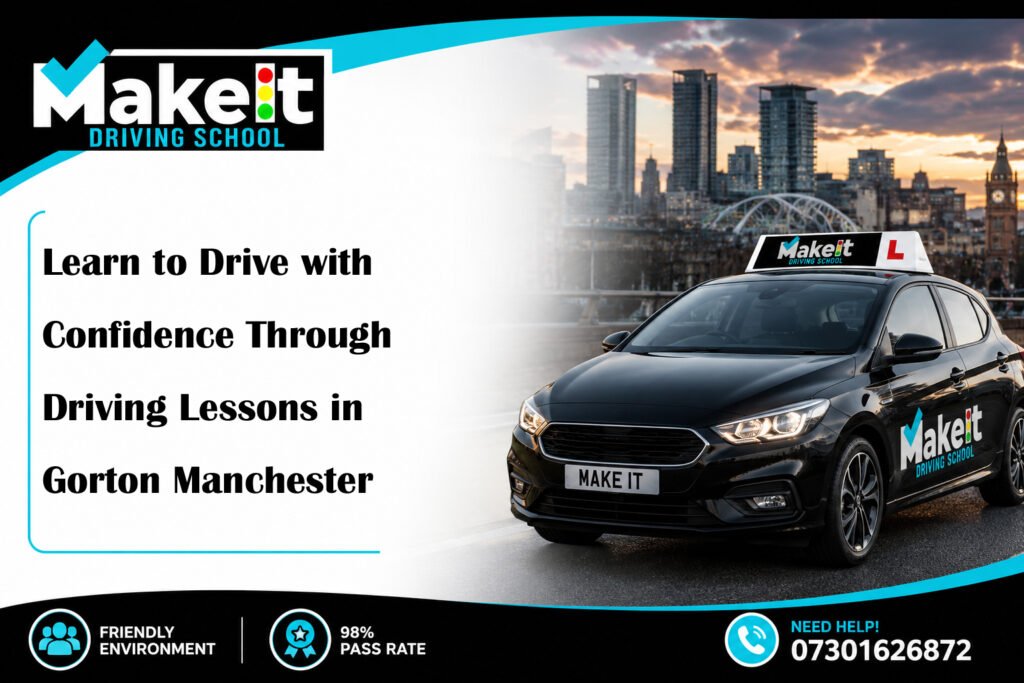
Learning to drive is an important milestone that can open up new opportunities for work, education, travel, and everyday independence. For beginners in Gorton, Manchester, choosing professional driving lessons can help make the experience more structured, comfortable, and rewarding. With suitable instruction, regular practice, and a positive attitude, learners can develop the skills needed to handle different road conditions and become safer, more confident drivers.
Gorton is a well-connected area of Manchester, with residential streets, local shopping areas, junctions, and routes leading towards busier parts of the city. These different driving environments provide useful opportunities to practise vehicle control, observation, road positioning, and decision-making. Whether you are a complete beginner or someone returning to driving after a break, lessons can help you strengthen your abilities and become more comfortable behind the wheel.
Make It Driving School provides driving tuition across Manchester and aims to create a friendly, professional learning environment. By choosing a suitable lesson schedule and working consistently on your skills, you can build a strong foundation for independent driving and prepare for the practical driving test.
Why Choose Driving Lessons in Gorton Manchester?
Professional driving lessons provide beginners with structured guidance that can make learning more manageable. Rather than trying to understand every aspect of driving independently, you can learn through demonstrations, explanations, and practical exercises designed around your current ability.
An instructor can help you understand the vehicle’s controls, develop effective observation habits, and learn how to respond to changing road conditions. You can also receive feedback on mistakes and practise the techniques needed to improve. This makes it easier to recognise your progress and focus on areas that require additional attention.
Gorton’s mixture of residential and busier roads can help learners develop practical experience in different environments. Quieter streets may be suitable for practising basic vehicle control, while more demanding routes can introduce junctions, traffic lights, and other common urban driving situations when you are ready.
Professional lessons also help you develop responsible habits from the beginning. Safe driving involves more than operating a vehicle; it requires patience, awareness, planning, and consideration for other road users. Learning these principles early can support your development long after you pass the driving test.
Building Confidence from Your First Lesson
It is perfectly normal to feel nervous before your first driving lesson. You may be concerned about controlling the car, remembering instructions, responding to traffic, or making mistakes in front of other road users. These feelings are common among beginners and usually become easier to manage with practice.
Your first lesson will generally focus on the fundamentals. You may learn how to adjust your seat and mirrors, understand the main controls, recognise the function of the indicators, and prepare the vehicle before moving off. Your instructor can then introduce basic steering, braking, and vehicle movement in an appropriate environment.
Taking these steps gradually helps you become familiar with the driving process without feeling overwhelmed. Instead of trying to master everything at once, concentrate on understanding one skill before moving on to another.
Confidence develops through experience and preparation. As you become more familiar with the controls and start recognising common traffic situations, you may find it easier to concentrate on the road rather than worrying about every individual action.
It is also important to remember that mistakes are part of learning. If something goes wrong during a lesson, listen to your instructor’s feedback, understand what needs to change, and practise again when it is safe to do so.
Understanding Gorton’s Roads and Traffic Conditions
Driving in Gorton can help learners become familiar with the types of road conditions they may encounter during everyday journeys around Manchester. Residential roads require appropriate speed control, careful observation, and awareness of parked vehicles, pedestrians, and cyclists.
When passing parked cars, you need to assess the available space and consider whether another vehicle or vulnerable road user may be approaching. Maintaining a suitable position and avoiding sudden movements can help you negotiate these situations safely.
As your experience improves, you can progress to busier roads and more complicated junctions. These environments require you to observe traffic from different directions, interpret road signs and markings, and decide when it is safe to proceed.
Traffic lights, roundabouts, and pedestrian crossings are also important parts of urban driving. Each requires you to anticipate what other road users may do and adjust your actions accordingly. Your instructor can explain how to approach these situations and provide opportunities to practise them.
Road conditions can change throughout the day. Traffic density, parked vehicles, weather, and visibility may all affect how you should drive. Developing the ability to adapt to these changes is an important step towards becoming a confident and responsible driver.
Developing Essential Vehicle Control Skills
Good vehicle control provides the foundation for safe driving. Beginners need to understand how to move off smoothly, stop safely, steer accurately, and maintain control while travelling at different speeds.
In a manual car, these skills also involve learning how to coordinate the clutch, accelerator, brake, and gears. This may initially require considerable concentration, particularly when moving away or stopping in traffic. Repeated practice can help these movements become more familiar.
Automatic vehicles remove the need to operate a clutch pedal and manually change gears in the same way. This can allow some learners to concentrate more directly on steering, observation, positioning, and the traffic environment.
Regardless of the vehicle type, you need to learn how to maintain a suitable speed and position. Driving too quickly for the conditions can reduce your reaction time, while poor positioning can create unnecessary risks when passing obstacles or approaching junctions.
Smooth acceleration and braking are also valuable skills. They help maintain control, improve passenger comfort, and make your actions more predictable for other road users.
An instructor can assess your progress and help you develop these skills through practical exercises. The objective is to build reliable control that you can maintain in different driving situations.
Improving Observation and Road Awareness
Observation is one of the most important skills you will develop during driving lessons. It allows you to understand what is happening around your vehicle and identify potential hazards before they become difficult to manage.
You need to check your mirrors when appropriate, look well ahead, and remain aware of vehicles, pedestrians, cyclists, and other road users. Before changing direction, moving away, or adjusting your road position, you must make the observations necessary to determine whether the action is safe.
Beginners sometimes concentrate so heavily on steering or the vehicle’s controls that they forget to look further ahead. This can make it harder to anticipate changes in traffic or recognise hazards early.
Your instructor can help you develop an effective observation routine and explain when additional checks are required. For example, changing lanes or completing a manoeuvre may require you to check areas that are not fully visible in your mirrors.
Good road awareness also involves anticipating possible hazards. A pedestrian standing near a crossing, a cyclist approaching a junction, or a vehicle slowing ahead may require you to adjust your speed or position.
By practising these habits consistently in Gorton and other parts of Manchester, you can become more aware of your surroundings and make better-informed decisions.
Manual or Automatic Driving Lessons: Which Should You Choose?
One of the first decisions for many beginners is whether to learn in a manual or automatic car. Both options can help you develop safe driving skills, but the learning experience differs depending on the vehicle’s controls.
Manual lessons involve learning how to coordinate the clutch, accelerator, brake, and gear selection. You will need to practise moving off smoothly, changing gears, stopping safely, and managing the clutch in different situations. Although these skills may seem challenging at first, they can become more natural with regular practice.
Automatic lessons remove the need to operate a clutch pedal and manually change gears in the same way. Some beginners find this easier because they can concentrate more directly on road awareness, steering, speed control, and traffic decisions.
Your choice should depend on your preferences, future vehicle plans, and the type of licence you want. If you intend to drive a manual car after passing, manual tuition may be appropriate. If you prefer automatic vehicles, learning in an automatic car may better suit your needs.
It is important to understand that passing your test in an automatic vehicle generally restricts you to driving automatic cars unless you complete the required test to obtain manual entitlement.
For a more detailed comparison, read this guide to manual vs automatic driving. Considering the advantages and practical differences can help you decide which option is suitable for your circumstances.
Learning to Handle Junctions and Roundabouts
Junctions and roundabouts can feel challenging for beginners because they require several decisions within a short period. You need to assess the road layout, observe other vehicles, select an appropriate position, and decide when it is safe to proceed.
When approaching a junction, it is important to assess the situation early and adjust your speed accordingly. You should check relevant signs and markings, make the necessary observations, and avoid rushing because another vehicle is waiting behind you.
Roundabouts require particular attention to lane selection, positioning, signalling, and traffic movement. You must understand which lane is appropriate for your intended exit and remain aware of vehicles already using the roundabout.
Your instructor can introduce these situations gradually and explain the steps involved. Repeating similar exercises can help you become more comfortable, while practising different layouts develops your ability to adapt to unfamiliar situations.
The aim is not to memorise every junction you encounter. Instead, you should understand the principles of safe observation, positioning, and decision-making so that you can apply them wherever you drive.
With regular practice, these situations can become easier to manage and less intimidating.
Developing Safe Driving Habits for Everyday Journeys
Learning to drive is about more than passing a test. It also involves developing habits that help you remain safe and considerate when travelling independently.
One important habit is maintaining a safe following distance. Leaving enough space between your vehicle and the one ahead gives you more time to react if traffic slows suddenly. This is especially important on busy urban roads.
Speed management is equally essential. You should consider road conditions, visibility, traffic, and the presence of pedestrians or cyclists when choosing an appropriate speed. Posted speed limits are not a target that must always be reached; driving at a safe speed for the conditions is the priority.
You should also avoid distractions. Mobile phones, unnecessary adjustments to vehicle controls, and other distractions can take your attention away from the road. Building a habit of remaining focused during lessons supports safer driving after you qualify.
Another valuable habit is anticipating the actions of other road users. Vehicles may stop unexpectedly, cyclists may need additional space, and pedestrians may approach crossings. Looking ahead and planning your response can reduce the need for sudden reactions.
These habits should become part of every journey, whether you are travelling around Gorton, commuting to work, or driving to another part of Manchester.
How Regular Driving Lessons Support Your Progress
Consistency plays an important role in developing practical driving skills. Regular lessons provide opportunities to revisit techniques, correct mistakes, and gradually progress to more demanding situations.
If there is a long gap between sessions, you may need additional time to regain familiarity with certain controls or manoeuvres. A manageable schedule can help you maintain continuity and build on your previous experience.
It is helpful to review your instructor’s feedback after each lesson. Think about which skills you performed well, where you experienced difficulties, and what you should practise next. This makes your lessons more focused and allows you to recognise progress over time.
For example, if you struggle with roundabouts, additional practice can help you improve lane selection, observation, and judgement. If you find parking difficult, your instructor can provide exercises to develop accurate positioning and reversing control.
Every learner progresses differently. Your previous experience, confidence, lesson frequency, and ability to apply feedback will all influence how quickly you develop. Avoid comparing yourself with other learners and concentrate on becoming a safe, capable driver.
Preparing for Your Practical Driving Test
For many learners, passing the practical driving test is a major goal. However, the best preparation focuses on developing the ability to drive safely and independently rather than simply memorising a route.
The test assesses several areas, including vehicle control, observation, road positioning, response to signs and signals, and awareness of hazards. You may also be asked to complete a reversing manoeuvre and demonstrate your understanding of vehicle safety.
During lessons, your instructor can help you practise these skills and identify areas that need improvement. Mock tests can also be useful because they provide an opportunity to experience a more formal assessment environment.
If you make a mistake during practice, try to understand why it happened instead of becoming distracted by it. Recognising errors and learning how to respond safely are important parts of preparation.
You should also practise driving independently by following road signs or navigation instructions while remaining aware of traffic conditions. The ability to make safe decisions without constant guidance is essential.
Before arranging your test, discuss your progress with your instructor. You should aim to demonstrate the required skills consistently rather than booking solely because you have completed a certain number of lessons.
Choosing a Suitable Driving Instructor in Gorton
The instructor you choose can make a difference to your overall learning experience. Beginners often benefit from clear explanations, constructive feedback, and a teaching approach that matches their current ability.
When comparing driving schools, consider instructor communication, lesson availability, prices, and whether manual or automatic tuition is available. It is also sensible to ask about lesson duration, cancellation arrangements, and any additional costs before making a booking.
A supportive instructor should help you understand your mistakes and explain how to correct them. You should feel comfortable asking questions whenever an instruction is unclear.
The structure of lessons is also important. A good training approach introduces skills in a suitable order, revisits areas that need more practice, and gradually prepares you for more complex road conditions.
Make It Driving School describes its teaching approach as friendly and professional, with driving tuition available across Manchester. Before booking, discuss your goals and requirements directly with the school so you can understand the current options.
Choosing an instructor who communicates well and provides appropriate guidance can help you build confidence and make your training more productive.
Overcoming Nervousness Behind the Wheel
Many new drivers experience nervousness, particularly when they first encounter busy traffic or unfamiliar roads. You may worry about making mistakes, responding too slowly, or holding up other vehicles.
The best way to address these concerns is to develop your skills gradually and practise in suitable conditions. Start with the fundamentals and progress as your instructor determines that you are ready.
If a particular situation makes you uncomfortable, explain it to your instructor. You may benefit from spending more time on junctions, roundabouts, parking, or driving in heavier traffic.
Avoid putting unnecessary pressure on yourself to perform perfectly during every lesson. Driving involves many interconnected skills, and mistakes can provide useful information about what you need to practise.
Preparation can also help reduce anxiety before your practical test. Understanding the test format, practising essential manoeuvres, and receiving feedback on your progress can make the assessment feel more familiar.
Confidence should always be supported by safe driving habits. The goal is not to eliminate caution but to develop the knowledge and judgement needed to handle situations calmly and responsibly.
Book Driving Lessons in Gorton Manchester
If you are ready to start driving lessons in Gorton, Manchester, choosing a suitable driving school is an important first step. Professional tuition can help you understand vehicle controls, improve observation, practise different road situations, and prepare for your practical test.
Make It Driving School offers driving tuition across Manchester and provides course options for learners with different levels of experience and availability. Whether you are a complete beginner or looking to improve particular skills, you can discuss your goals and ask about suitable lesson arrangements.
Before booking, consider whether you prefer manual or automatic lessons, how frequently you can attend, and which areas of driving you would like to improve. Confirm current prices, lesson availability, and course details directly with the school.
To ask questions or arrange your next steps, contact Make It Driving School. You can also call 07301 626872 to enquire about available driving lessons.
Final Thoughts
Learning to drive with confidence through professional driving lessons in Gorton Manchester starts with choosing suitable instruction, practising consistently, and developing a strong understanding of road safety. From basic vehicle control to handling junctions, roundabouts, and changing traffic conditions, each lesson can help you build the skills required for independent driving.
Remember that every learner progresses at a different pace. Focus on understanding your instructor’s feedback, correcting mistakes, and improving your observation and decision-making rather than rushing towards the test.
Choosing between manual and automatic lessons is another important part of planning your training. Consider your future driving needs and preferred learning experience before deciding which option is right for you.
With regular practice, a responsible attitude, and professional guidance, you can work towards becoming a safer and more confident driver. Contact Make It Driving School to discuss your requirements and explore driving lesson options in Gorton, Manchester.