
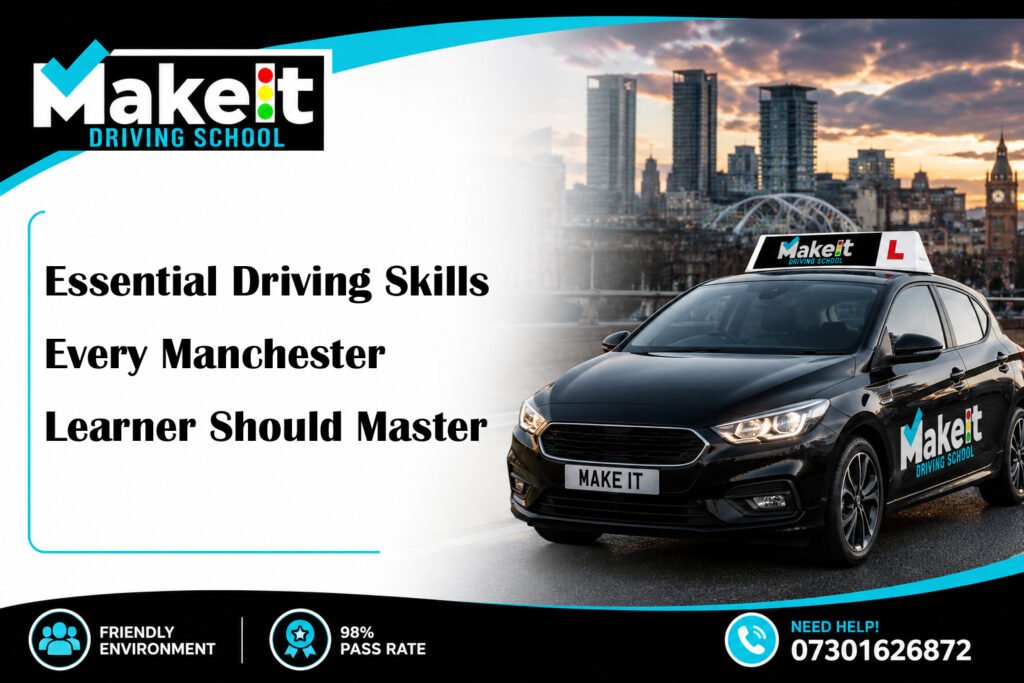
Learning to drive is an important step towards greater freedom, independence and confidence on the road. For learners in Manchester, becoming a safe and capable driver involves much more than simply learning how to control a car and pass the practical driving test. Manchester has a wide variety of roads and driving environments, from busy city-centre streets and complicated junctions to residential areas, dual carriageways, roundabouts and motorway connections. Developing the right skills during your driving lessons can help you become a safer and more confident driver for life.
At Make It Driving School, we understand that every learner progresses differently. Our goal is to provide a safe, professional and enjoyable learning experience while helping students develop the practical skills and road awareness they need. We have been serving learners in Manchester since 2015, offering manual and automatic driving lessons with DVSA-approved instructors.
Whether you are completely new to driving, returning to lessons after a break or preparing for your practical driving test, understanding the essential skills you need to master can make your learning journey much easier.
Understanding the Roads Around Manchester
Manchester offers learners a valuable mixture of driving situations. A student may experience quiet residential roads during one lesson and then encounter busy traffic, multi-lane roads or complex junctions during another.
This variety is useful because it allows learners to develop experience in different environments. Driving confidently in Manchester means learning how to observe what is happening around you, plan ahead and make safe decisions.
A good learner should gradually become comfortable with:
Residential streets
Busy urban roads
Multi-lane roads
Roundabouts
Traffic lights
Pedestrian crossings
Bus lanes
One-way systems
Dual carriageways
Junctions with multiple exits
Parking areas
Hills and slopes
Heavy traffic
Different weather and road conditions
Your instructor can introduce these situations progressively as your skills improve.
1. Steering Control
One of the first skills every learner needs to develop is proper steering control. Steering may seem simple, but maintaining accurate control becomes particularly important when driving through narrow streets, negotiating bends or dealing with busy Manchester roads.
A learner should be able to maintain a suitable road position while steering smoothly. Sudden steering movements can make the vehicle unstable and may create unnecessary risks for other road users.
Good steering involves looking well ahead rather than concentrating only on the immediate area in front of the vehicle. Your hands should remain in a comfortable position and you should avoid making unnecessary movements.
As your confidence improves, steering should become more natural, allowing you to concentrate more on observation, planning and traffic.
2. Moving Off Safely
Moving off is another fundamental driving skill. Learners need to understand how to prepare the car, check the surroundings and move away safely without affecting other road users.
Before moving off, you should consider:
Your mirrors
Blind spots
Pedestrians
Cyclists
Motorcyclists
Parked vehicles
Approaching traffic
Your intended direction
You also need to understand how to control the clutch and accelerator if you are learning in a manual car.
For automatic learners, the process may be different, but observation and safe decision-making remain equally important.
Practising moving off in different Manchester locations can help you become comfortable with traffic lights, parked cars, slopes, junctions and busy roads.
3. Effective Mirror Use
Good mirror use is one of the most important skills for safe driving.
Mirrors allow you to understand what is happening behind and around your vehicle. However, simply looking at a mirror is not enough. You need to develop a habit of checking mirrors at the correct time and understanding what you see.
You should become familiar with checking your mirrors before:
Changing direction
Changing lanes
Slowing down
Stopping
Moving around parked vehicles
Joining traffic
Moving away from the kerb
Turning at junctions
Overtaking or passing slower traffic
Your instructor can help you develop effective mirror routines so that mirror checks become a natural part of your driving.
4. Observation and Awareness
Observation is at the centre of safe driving.
A good driver does not only react to what is happening immediately in front of the vehicle. They continuously look ahead, identify potential hazards and consider what might happen next.
For example, if you see a pedestrian standing near a crossing, you should already be considering whether they may cross. If you see brake lights several vehicles ahead, you should begin preparing for possible slowing traffic.
Manchester roads can become busy, so developing strong observation skills is particularly important.
You should learn to look:
Far ahead
To the sides
In mirrors
At junctions
Around parked vehicles
For pedestrians
For cyclists
For motorcyclists
For road signs
For changing traffic conditions
Strong observation helps you make decisions earlier and more safely.
5. Speed Management
Speed is not simply about following the posted speed limit. Good speed management means choosing a safe speed for the conditions.
A road may have a 30 mph speed limit, but that does not mean 30 mph is always appropriate. Heavy traffic, parked cars, pedestrians, poor visibility, rain, roadworks or a complicated junction may require you to adjust your speed.
Learners should develop the ability to:
Read speed limit signs
Recognise changes in speed limits
Slow down before hazards
Maintain appropriate speed through bends
Adjust speed for weather
Avoid driving unnecessarily slowly
Avoid exceeding safe speeds
Good speed control gives you more time to observe, plan and react.
6. Junctions
Junctions are a major part of everyday driving and are an important area of practical test preparation.
Manchester has many different junction layouts. Learners may encounter simple T-junctions, crossroads, staggered junctions, traffic-light-controlled junctions and larger multi-lane junctions.
You need to learn how to approach junctions safely, understand road signs and markings, select the correct lane and make suitable observations.
When approaching a junction, avoid rushing. Give yourself enough time to understand the road layout and decide what you need to do.
Good planning can make junctions much easier.
7. Roundabout Skills
Roundabouts are another essential skill for Manchester learners.
A roundabout can initially seem complicated because you need to consider traffic approaching from different directions while also choosing the correct lane and exit.
The key skills include:
Choosing the correct lane
Understanding road markings
Giving appropriate signals
Checking mirrors
Looking for approaching traffic
Maintaining suitable speed
Positioning correctly
Moving off safely when there is a suitable gap
Exiting smoothly
Learners should practise different types of roundabouts rather than becoming comfortable with only one familiar route.
With regular practice and good instruction, roundabouts can become much easier to manage.
8. Lane Discipline
Lane discipline is essential on multi-lane roads and dual carriageways.
You should understand which lane you need and avoid unnecessary lane changes. Before changing lanes, you need to check your mirrors, assess the surrounding traffic and make sure there is enough space.
Manchester learners may encounter busy multi-lane roads where traffic moves at different speeds. Developing good lane discipline helps you remain predictable to other road users.
A safe driver plans lane changes early rather than waiting until the last moment.
9. Changing Lanes Safely
Changing lanes requires observation, planning and good vehicle control.
Before changing lanes, check your mirrors and assess your blind spot where necessary. You should also consider the speed and position of vehicles around you.
Do not assume that another driver has seen you. Make your intentions clear and only move when it is safe.
Your instructor can help you practise lane changes in increasingly challenging traffic conditions.
10. Pedestrian and Cyclist Awareness
Manchester is home to many pedestrians and cyclists, particularly around busy areas, shopping streets, residential areas and transport routes.
Learners need to understand that vulnerable road users may behave differently from vehicles.
You should look carefully for:
Pedestrians crossing roads
Children near schools
Cyclists approaching junctions
Cyclists travelling alongside traffic
Pedestrians near parked vehicles
People stepping into the road
Cyclists in blind spots
Give vulnerable road users plenty of space and time. Avoid making assumptions about what another person is going to do.
11. Traffic Light Awareness
Traffic lights are common throughout Manchester and require good observation.
Learners should understand the meaning of different signals and be prepared for changing traffic conditions.
Do not focus only on the traffic light directly in front of you. Look at the road environment as a whole.
You should also learn to recognise pedestrian crossings, advanced stop lines and situations where traffic may begin moving suddenly.
Good observation helps you anticipate what is happening instead of reacting at the last second.
12. Parking Skills
Parking is an important part of becoming an independent driver.
Learners should become comfortable with different parking situations, including:
Parallel parking
Bay parking
Forward parking
Reverse parking
Parking near the kerb
Parking on residential streets
The objective is not simply to complete a manoeuvre during the driving test. You should be able to park safely and confidently in everyday situations.
Take your time, observe carefully and remember that safety is more important than speed.
13. Reversing Skills
Reversing requires careful observation and good control.
Before reversing, make sure you understand your surroundings. Check for pedestrians, cyclists, vehicles and obstacles.
You should practise reversing in different environments so you can understand how the car behaves when manoeuvring at low speed.
Good reversing skills can also make everyday parking much easier after you pass your test.
14. Hill Starts
Manchester learners may encounter roads with different gradients, so learning how to control the vehicle on a hill is useful.
Manual learners need to understand clutch control, braking and acceleration when moving away on a slope. Automatic learners should also understand how to control the vehicle safely on inclines.
Hill starts should be practised until you can perform them smoothly without becoming stressed by traffic behind you.
15. Dealing With Busy Traffic
Busy traffic can be intimidating for new drivers.
Manchester can experience congestion during peak periods, so learners need to understand how to remain calm when traffic slows down.
Avoid becoming focused on the vehicle directly ahead. Continue observing the wider road environment and leave enough space between your vehicle and the vehicle in front.
Good anticipation is especially valuable in congestion because it allows you to slow down smoothly rather than repeatedly braking heavily.
16. Hazard Perception
Hazard perception is an important part of becoming a safe driver and is also relevant to the theory test.
A hazard is something that could require you to change speed or direction.
Examples include:
Pedestrians near the road
Cyclists
Parked vehicles
Junctions
Vehicles emerging from side roads
Children near schools
Roadworks
Changing traffic conditions
Animals
Emergency vehicles
The earlier you identify potential hazards, the more time you have to respond safely.
This is why experienced drivers often appear to make decisions effortlessly. They are continuously scanning the road and predicting what may happen next.
17. Planning Ahead
Planning is one of the biggest differences between a nervous learner and a confident driver.
Instead of waiting until the last moment to decide what to do, look ahead and prepare.
If you know that you need to turn left in a few hundred metres, start thinking about your position and route early.
Planning ahead can help you:
Choose lanes correctly
Reduce sudden braking
Avoid unnecessary lane changes
Prepare for junctions
Respond to hazards
Maintain a smooth speed
Reduce stress
Good drivers are constantly planning several seconds ahead.
18. Understanding Road Signs and Markings
Road signs and road markings provide important information.
Learners should understand common signs relating to:
Speed limits
Give way
Stop
No entry
Parking restrictions
Bus lanes
One-way roads
Pedestrian areas
Roadworks
Lane directions
Road markings are equally important. Lines on the road can tell you where you should position the vehicle, where you can stop and how lanes are organised.
Learning these signs and markings can improve both your practical driving and theory test preparation.
19. Driving in Different Weather Conditions
Driving skills should not only be developed in perfect weather.
Rain can reduce visibility and increase stopping distances. Strong sunlight can make it difficult to see certain road users or signs. Fog and poor visibility require additional care.
Learners should understand how to adjust their driving according to conditions.
This may involve:
Reducing speed
Increasing following distance
Using appropriate lights
Making smoother controls
Paying closer attention to pedestrians
Allowing more time to stop
Your instructor can help you understand how weather affects the way your vehicle behaves.
20. Building Confidence Without Becoming Overconfident
Confidence is essential, but overconfidence can be dangerous.
A good learner should become confident enough to make decisions while still recognising their limitations.
Confidence comes from:
Regular practice
Understanding road rules
Learning from mistakes
Driving in different environments
Improving observation
Developing vehicle control
Receiving professional instruction
The aim is not to become fearless. The aim is to become calm, responsible and capable.
Preparing for Your Manchester Driving Test
As you approach your practical driving test, your instructor should help you develop the ability to drive independently.
You should be able to follow directions, make safe decisions and deal with normal road conditions without constant assistance.
Test preparation should include different roads and traffic situations rather than simply repeating the same route.
It can also be helpful to practise areas where you personally feel less confident.
If you want more advice about improving your preparation, read our guide on how to pass your driving test faster in Manchester.
From Nervous Learner to Confident Driver
Many learners feel nervous when they first sit behind the wheel. This is completely understandable. You are learning to control a vehicle while observing traffic, signs, pedestrians and other road users at the same time.
The right teaching approach can make a major difference.
A calm instructor can help break driving into manageable stages. As your skills improve, you can gradually move into more complicated traffic situations.
At Make It Driving School, we focus on building confidence, road awareness and responsible driving habits. Our instructors aim to create a friendly and supportive learning environment where students can develop at their own pace.
You can also read our guide on going from nervous to confident with driving lessons in Manchester.
Why Choose Make It Driving School in Manchester?
Choosing the right driving school can have a significant impact on your learning experience. At Make It Driving School, we have been helping learners in Manchester since 2015.
DVSA-Approved Instructors
Our professional instructors are DVSA-approved and provide both manual and automatic driving lessons. You can learn with an instructor who understands the importance of safe driving, road awareness and effective preparation.
Manual and Automatic Driving Lessons
Different learners have different preferences. We offer manual and automatic driving lessons so you can choose the type of vehicle that suits your goals.
98% Pass Rate
Our proven teaching methods have helped us achieve a 98% pass rate. We focus on developing real driving skills rather than simply teaching learners to memorise a test route.
Friendly and Supportive Environment
Learning to drive can feel stressful at times. Our instructors aim to create a calm and friendly environment where learners can ask questions, practise their skills and gradually build confidence.
Flexible Lessons
We understand that learners have work, school, university and other commitments. Evening and weekend lessons are available to make learning to drive more convenient.
Door-to-Door Pickup
Our driving lessons can include convenient pickup and drop-off, helping make your lessons easier to fit into your routine.
Regular and Crash Courses
Learners can choose from different training options depending on their availability and goals.
Our Standard Course is designed around approximately 2 to 4 hours of lessons each week.
Our Crash Course provides approximately 6 to 8 hours of training each week for learners who want a more intensive approach.
The right option depends on your experience, availability, learning speed and individual circumstances.
Why Local Manchester Experience Matters
Learning to drive in Manchester means dealing with real local road conditions.
A learner who only practises on quiet roads may feel unprepared when they encounter busy junctions, complicated roundabouts, heavy traffic or multi-lane roads.
Local driving lessons allow you to gain experience in different environments while being guided by a professional instructor.
Over time, this can help you become more comfortable with the roads you are likely to use after passing your test.
How Regular Practice Can Improve Your Driving
Driving skills improve through repetition.
A single lesson can introduce a new skill, but repeated practice helps turn that skill into a natural habit.
For example, you may initially need to think carefully about checking mirrors before changing speed. After enough practice, mirror checks become part of your normal driving routine.
The same applies to:
Junctions
Roundabouts
Parking
Lane changes
Moving off
Reversing
Speed control
Hazard awareness
Consistency is one of the most important factors in becoming a capable driver.
What Makes a Good Manchester Learner?
A good learner does not need to be perfect from the beginning.
Instead, good learners are willing to:
Listen to their instructor
Ask questions
Practise regularly
Learn from mistakes
Stay patient
Improve observation
Follow road rules
Develop good habits
Take responsibility for their decisions
Every driver starts somewhere. The important thing is to continue improving.
Start Your Driving Journey With Make It Driving School
Learning to drive is about much more than passing a test. The skills you develop during your lessons can influence how safely and confidently you drive for many years.
For Manchester learners, developing strong observation, vehicle control, planning, speed management, lane discipline, junction skills, parking ability and hazard awareness is essential.
At Make It Driving School, we are committed to providing a safe, professional and enjoyable learning experience. Since 2015, we have helped learners develop their driving skills with professional instruction, flexible lesson options and a supportive approach.
Whether you are starting from scratch or preparing for your practical test, our instructors can help you work towards becoming a confident and responsible driver.
Ready to Start Learning?
If you are looking for professional driving lessons in Manchester, contact Make It Driving School today.
Call us on 07301626872 to discuss your driving lessons and find an option that suits your needs.
You can also contact Make It Driving School to book your lessons.
Start learning today, build your confidence and prepare for a safer future on Manchester’s roads.